Introduction
Why am I getting two different instructions?
Recently, a patient came to our practice feeling a little unsure. He uses testosterone gel and is also being treated by a urologist. His urologist had told him to apply the gel as usual in the morning before his blood test. We, on the other hand, ask our patients to apply the gel only after the blood draw. So who is right?
The answer: both. The two instructions do not contradict each other. Each blood test answers a different, equally useful question. In this post, we explain what is behind it.
Why does timing matter?
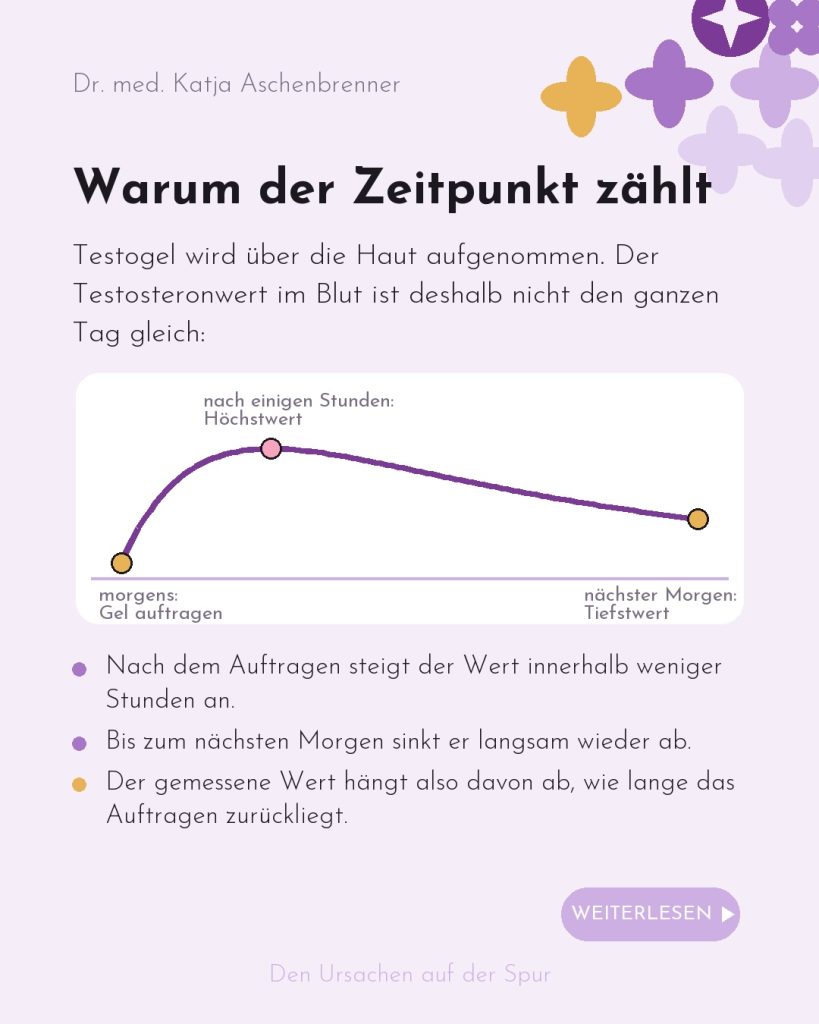
Testosterone gel (e.g. Testogel) is absorbed through the skin. After application, the testosterone level in the blood rises within a few hours. It reaches its peak during the day and then slowly declines until the next morning.
So the level is not the same all day long. It depends on how many hours have passed since the gel was applied. The same patient can therefore have very different testosterone levels on the same day, depending on when the blood is drawn.
What are the two time points for blood testing?
There are two recognized ways to monitor testosterone levels during treatment. Both are correct, as long as you know which one was chosen.
1. A few hours after application
This value shows how well the gel is absorbed through your skin and what level is reached during the day. This is how many urologists proceed, and it is in line with the recommendations of international medical societies.
2. In the morning before application
This value shows the lowest level, i.e. whether the effect of the gel lasts until the next morning and you are adequately supplied around the clock. This is how it is described in the manufacturer’s prescribing information, and this is how we do it in our practice. A slightly lower value is to be expected here and is no cause for concern, because it is exactly this lowest value that is compared with the target range.
Why can’t the two values be compared?
A value measured a few hours after application is naturally higher than a value measured before application. If you put an afternoon value from your urologist next to a morning value from our practice, you will see seemingly large fluctuations, even though nothing has actually changed. Only values measured under the same conditions are meaningful.
How do we do it in our practice?
To keep your values comparable over months and years, we stick to a fixed routine:
- Always the same laboratory
- Always at about the same time in the morning
- Always without applying the gel beforehand: the gel is applied only after the blood draw.
This creates a series of measurements in which you and we can see whether anything is changing.
What should you keep in mind before every blood test?
- Blood test at your urologist’s practice: Follow your urologist’s instructions. They apply to the blood draw there.
- Blood test at our practice: Apply the gel only after the blood draw.
- In both cases: Write down when you last applied the gel and mention it at the blood draw.
- Never apply the gel to the arm from which blood will be drawn, and wash your hands thoroughly afterwards. Gel residue at the puncture site or on your hands can significantly distort the result.
Conclusion: Not a mistake, but two different questions
If two practices give you different instructions, it is not a mistake. One measurement shows the peak level, the other shows whether your supply lasts until the next morning. The only important thing is not to mix up the values and to state when you last applied the gel at every blood test.
Important Note:
The blog posts serve general education and information purposes. They cannot and should not replace medical advice, diagnosis or treatment in any case. You should therefore not use the information provided here as the sole basis for health-related decisions. If you have any complaints, you should in any case seek professional medical advice.
Blog „Lebendig Lang Leben“
Wie können Sie Gesund-Werden? Wie Gesund-Bleiben? Die ganzheitliche Ärztin und Autorin Dr. med. Katja Aschenbrenner erzählt aus der Praxis über moderne Ganzheitsmedizin, Darmgesundheit, Hormone, Ayurveda und alles, was uns lebendig hält – für alle, die ihre Gesundheit verstehen und ihre Vitalität nachhaltig stärken wollen.
Über Dr. med. Katja Aschenbrenner
Ich bin Dr. med. Katja Aschenbrenner. Wenn niemand die Ursache findet, fängt meine Arbeit an. Ich helfe Menschen mit dauernder Erschöpfung, unklaren Beschwerden oder chronischen Krankheiten, mit ganzheitlicher und funktioneller Medizin.
Vernetzen Sie sich mit mir
Bleiben Sie auf dem Laufenden und vernetzen Sie sich mit mir auf Social Media.
Weitere Einträge