Introduction
Did you know that testosterone is also a female hormone?
When people hear the word testosterone, they often think of men. However, women produce this hormone too. Testosterone is part of normal female physiology and acts in various tissues, including the brain and muscles.
During the menopause transition, it can therefore be appropriate to consider this hormone when assessing relevant symptoms. What matters is the overall picture: your symptoms, your medical history and their possible causes.
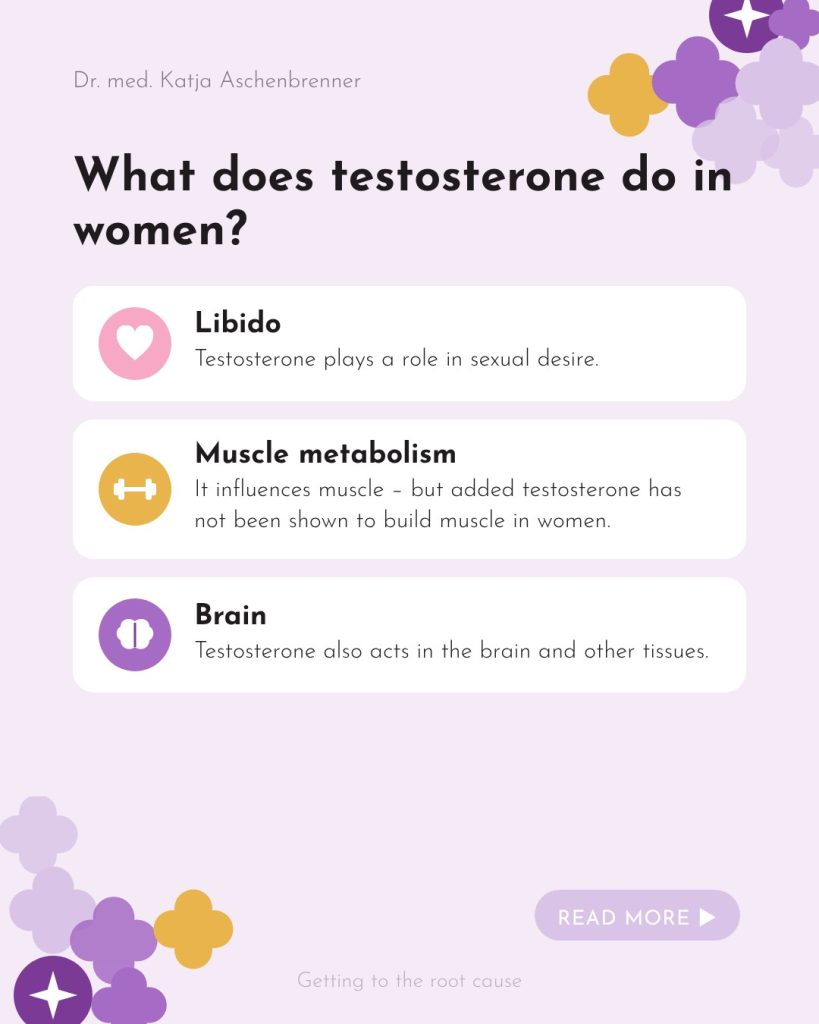
What does testosterone do in women?
Testosterone plays a role in libido and also influences muscle metabolism. Its effects are therefore not limited to one area of the body.
For muscles, however, an important distinction is needed: the hormone’s biological effects do not automatically mean that additional testosterone reliably improves muscle mass or strength in women. Such benefits have not been adequately established at doses that keep testosterone within the normal female range.
How does testosterone change throughout life?
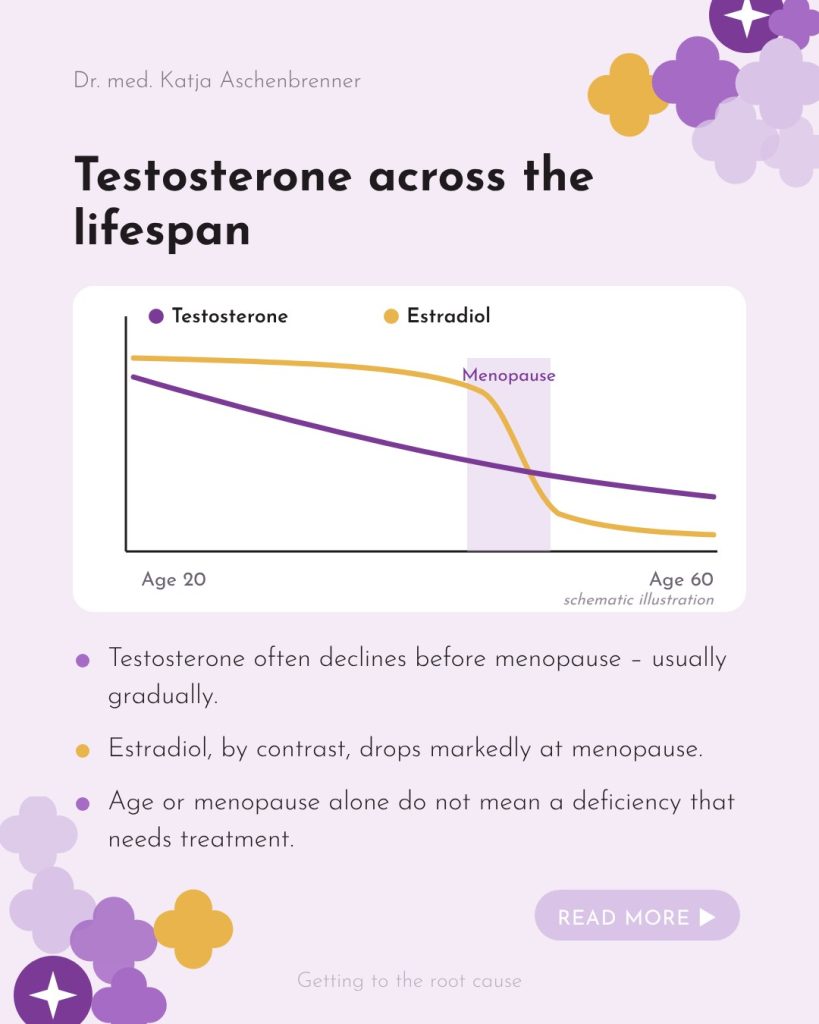
Testosterone levels decline in many women before the menopause transition. Natural menopause does not usually cause the characteristic sudden drop seen with estradiol. Removal of both ovaries, however, can lead to a substantial reduction in testosterone levels.
These changes vary between individuals. Age or menopause alone therefore cannot establish a testosterone deficiency requiring treatment.
Fatigue and low energy: Could hormones play a role?
If you experience persistent fatigue or low energy, these symptoms deserve a careful assessment. Hormonal changes may be considered alongside sleep problems, iron deficiency, thyroid disorders, medication effects and other medical conditions.
Low testosterone levels may also be present in women experiencing fatigue or low energy. Their presence does not establish that they are causing the symptoms. There is no generally recognised testosterone deficiency syndrome in women that can be reliably diagnosed from these symptoms and a single blood test.
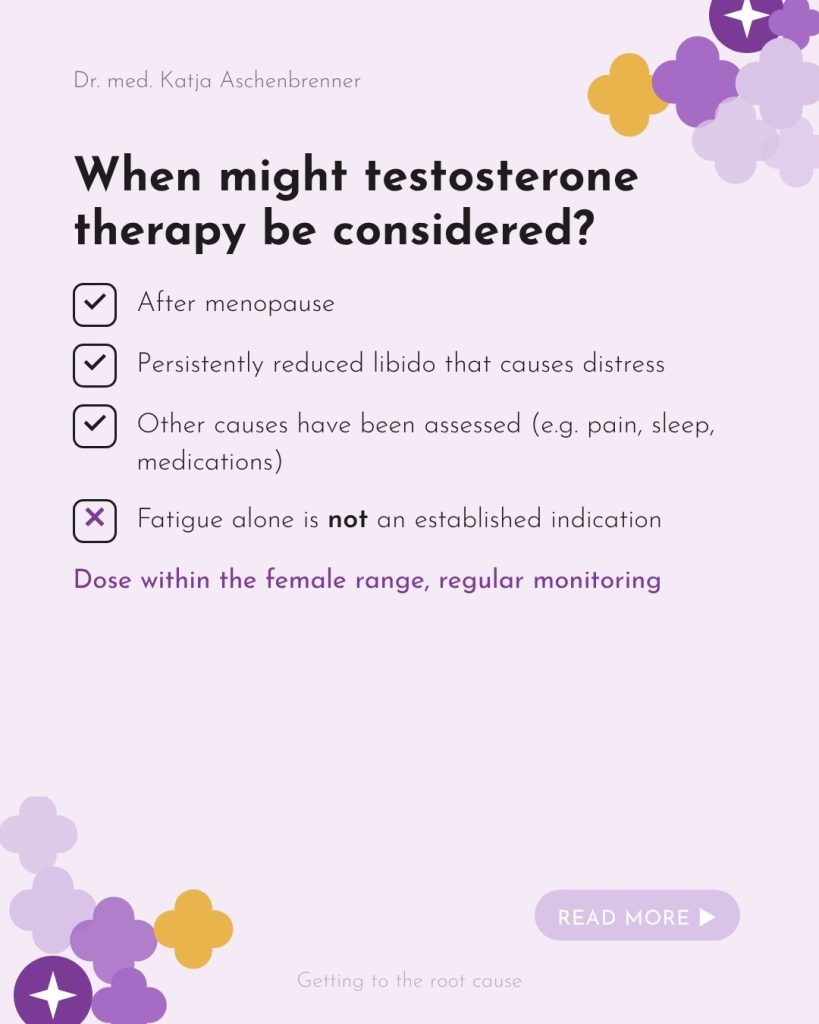
Testosterone therapy has not yet been shown to provide a sufficiently established benefit for fatigue or low energy. These symptoms alone are therefore not an established indication for treatment.
When might a blood test be useful?
A blood test may be useful when testosterone therapy is being considered. Its main purposes are to establish a baseline and identify levels that are already elevated. During treatment, follow-up tests help prevent excessively high testosterone levels.
A low result alone does not establish a deficiency requiring treatment. Symptoms and laboratory findings need to be assessed together.
Who might benefit from testosterone therapy?
The strongest evidence supports treatment for postmenopausal women with persistently reduced libido that causes distress. Other possible influences should first be considered, including pain, sleep problems, medications and relationship difficulties. Evidence for use before menopause is more limited.
Gel or cream: What options are available?
“Off-label” treatment
Germany currently has no testosterone product specifically approved for use in women. Treatment therefore usually involves use outside the product’s approved indication, known as “off-label” prescribing. This requires an individual medical decision and informed discussion.
Gel or individually compounded cream
A gel approved for men may be used at a substantially lower dose determined by the prescribing clinician. Individually compounded testosterone creams can also be prepared by a pharmacy. However, their effectiveness and safety are less well studied; international guidelines favour suitable standardised products when available.
Dosing and monitoring
Dosing should keep testosterone within the normal female range. Possible side effects include acne and increased hair growth. Assessment of your symptoms and regular monitoring are therefore part of treatment.
Conclusion: Getting to the root cause
If you notice changes in your libido, persistent fatigue or declining physical performance, discuss them with your clinician. The aim is to choose treatment that addresses the actual causes of your symptoms.
Dr. med. Katja Aschenbrenner
Getting to the root cause
Sources:
- Endocrine Society, Androgen Therapy in Women (JCEM 2014): academic.oup.com
- Global Consensus Position Statement on the Use of Testosterone Therapy for Women (JCEM 2019): academic.oup.com
- Australasian Menopause Society, Testosterone and women: menopause.org.au
- Endocrine Society, Clinical Practice Guideline: Androgen Therapy in Women: endocrine.org
- Monash Lens, Menopausal women don’t all need to check – or increase – their testosterone levels: lens.monash.edu
- ISSWSH Clinical Practice Guideline on testosterone therapy for women with HSDD (J Sex Med 2021): isswsh.org
- Review on testosterone therapy in women: pmc.ncbi.nlm.nih.gov
- AWMF S3 guideline on peri- and postmenopause (2026, German): register.awmf.org
- Global Consensus Position Statement (full text): pmc.ncbi.nlm.nih.gov
Important Note:
The blog posts serve general education and information purposes. They cannot and should not replace medical advice, diagnosis or treatment in any case. You should therefore not use the information provided here as the sole basis for health-related decisions. If you have any complaints, you should in any case seek professional medical advice.
Blog „Lebendig Lang Leben“
Wie können Sie Gesund-Werden? Wie Gesund-Bleiben? Die ganzheitliche Ärztin und Autorin Dr. med. Katja Aschenbrenner erzählt aus der Praxis über moderne Ganzheitsmedizin, Darmgesundheit, Hormone, Ayurveda und alles, was uns lebendig hält – für alle, die ihre Gesundheit verstehen und ihre Vitalität nachhaltig stärken wollen.
Über Dr. med. Katja Aschenbrenner
Ich bin Dr. med. Katja Aschenbrenner. Wenn niemand die Ursache findet, fängt meine Arbeit an. Ich helfe Menschen mit dauernder Erschöpfung, unklaren Beschwerden oder chronischen Krankheiten, mit ganzheitlicher und funktioneller Medizin.
Vernetzen Sie sich mit mir
Bleiben Sie auf dem Laufenden und vernetzen Sie sich mit mir auf Social Media.
Weitere Einträge