Introduction
Did you know the “weight-loss shot” can calm mast cells?
Many patients, for example those with MCAS, are puzzled when I suggest tirzepatide (Mounjaro®) or semaglutide (Ozempic® or Wegovy®) as a treatment: “But I don’t want to lose weight!” That is understandable – these medications became famous as the “weight-loss shot”.
For us, however, a different property matters most: they are anti-inflammatory and can calm overactive mast cells. In our experience, a fraction of the weight-loss dose is often enough. In this article I explain why – and who might benefit from microdosing.
What is GLP-1 and what does the medication do?
A natural gut hormone with docking sites all over the body
GLP-1 is a hormone produced by the gut. It is released after meals, regulates blood sugar and signals fullness to the brain. Tirzepatide and semaglutide are longer-acting “copies” of this hormone. Tirzepatide also acts on a second hormone receptor (GIP).
The key point: GLP-1 receptors are found not only in the pancreas and brain, but also on immune cells, blood vessel walls, nerve cells and mast cells. That is why the medication acts far beyond weight and blood sugar.
The anti-inflammatory effect – the truly interesting part
Mast cells: the immune system’s “alarm system”
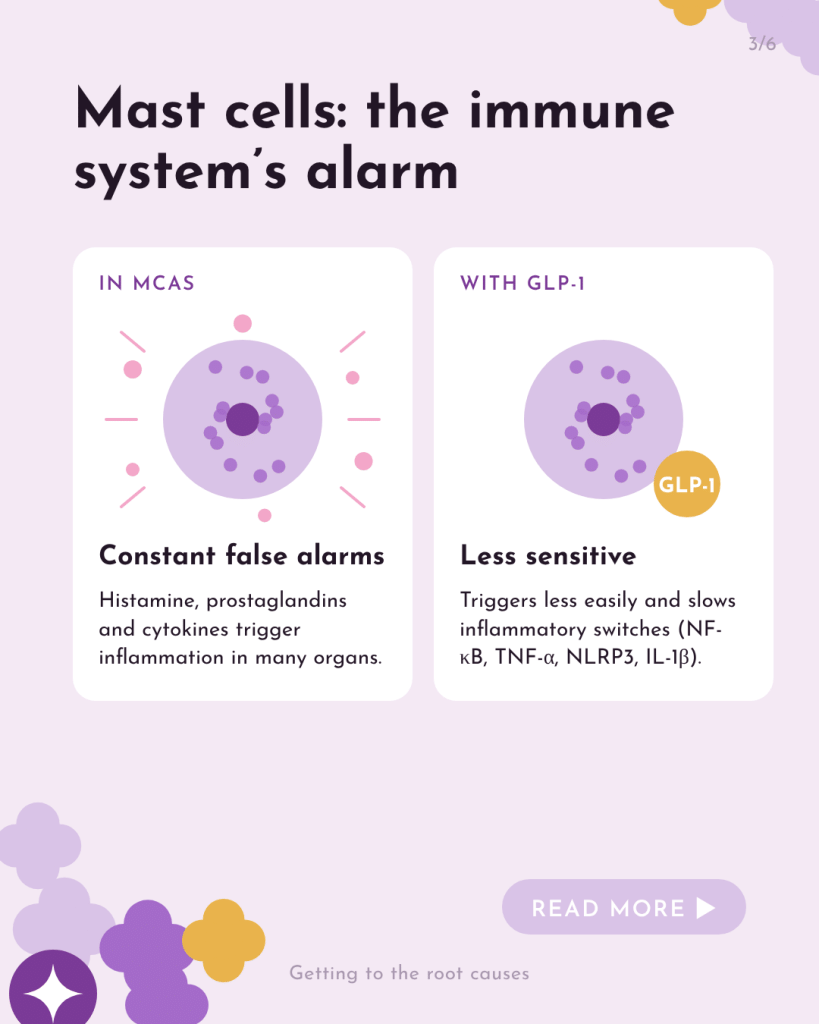
In mast cell activation syndrome (MCAS), this alarm is set too sensitive: it raises false alarms even in response to harmless triggers. It then releases too many mediators such as histamine, prostaglandins, and cytokines, which trigger inflammation in many organs at once.
GLP-1 makes the alarm less sensitive
GLP-1 medications appear to make mast cells less sensitive: they no longer react to every small stimulus, so there are fewer false alarms. In the lab, they reduce mast cell release and slow key inflammatory switches in the cell (NF-κB, TNF-α, the NLRP3 inflammasome, interleukin-1β).
Why so little? The principle of microdosing
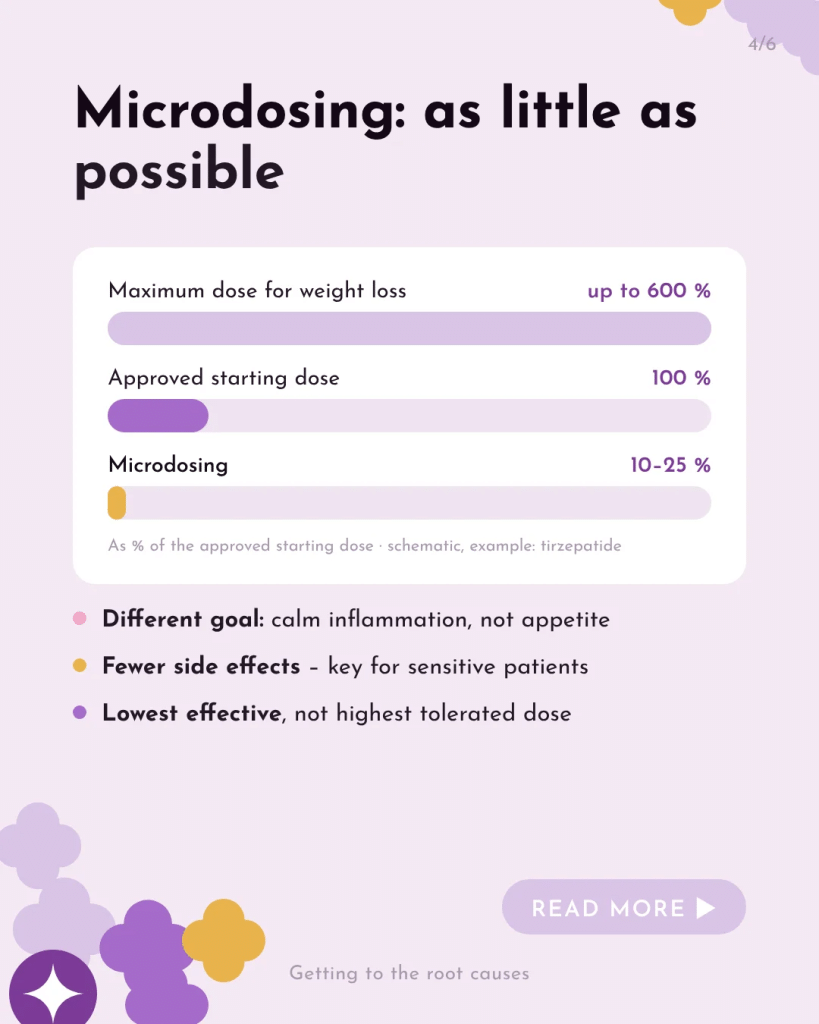
- The goal is different. We don’t want to switch off appetite. We want to calm mast cells and inflammation. Much smaller amounts seem to be enough.
- Fewer side effects. Nausea, bloating and constipation depend on the dose. At very low doses they are rare – important for sensitive MCAS and ME/CFS patients.
- Lowest effective dose, not highest tolerated dose. We start very low, at roughly 10–25 % of the approved starting dose, and increase only if needed and tolerated. Many patients stay on microdosing long-term.
- Weight: No one in our series became underweight. The medication tends to normalise weight. If someone is already underweight, we weigh the decision especially carefully.
What do we know in MCAS?
The first case series: 89 % clearly improved
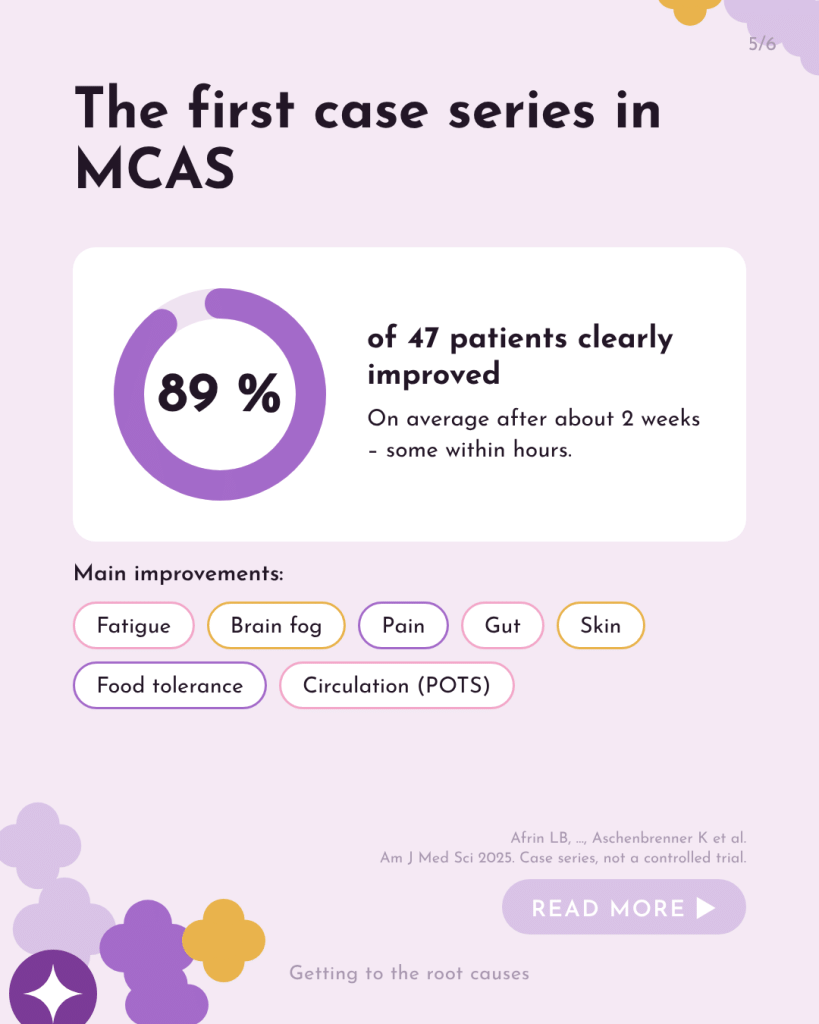
Together with the American MCAS specialists around Dr Lawrence Afrin, I published the first case series on GLP-1 medications in MCAS in 2025 (American Journal of the Medical Sciences). Of 47 patients in whom many other treatments had not been enough, 89 % clearly improved – on average after about two weeks, some within hours.
The main improvements were in fatigue, brain fog, pain, gut symptoms, skin reactions, food tolerance and circulatory problems (POTS). When treatment was paused, symptoms usually returned quickly and improved again once it was restarted.
What a case series can and cannot tell us
A case series is not a controlled trial. It shows that a treatment trial is worthwhile. Not everyone responds, and the medication does not replace other MCAS treatment (antihistamines, mast cell stabilisers, trigger avoidance). It adds to it.
What do we know in ME/CFS and Long COVID?
The evidence here is thinner: there is no published study specifically on ME/CFS yet. But there are good reasons to try.
Chronic inflammation, impaired blood flow in small vessels, overactive mast cells and a dysregulated autonomic nervous system play a central role in ME/CFS and Long COVID. Exactly the levers GLP-1 medications act on. Experienced ME/CFS physicians in the US report rapid improvements in fatigue, brain fog and circulation on very low doses.
How treatment works in practice
Administration and onset
The medication is injected under the skin once a week (abdomen or thigh). I set the starting dose and every increase individually with you. Effects often appear within 1–2 weeks. We assess the benefit after about 8–12 weeks.
Possible side effects
Possible side effects are nausea, bloating, constipation or loose stools, rarely headache – usually mild and temporary.
Who is it not suitable for?
It is not suitable, or only after careful consideration, during pregnancy, breastfeeding or when planning a pregnancy, after pancreatitis, with certain thyroid tumours in the family (medullary carcinoma, MEN2), with severe gastric emptying disorders, and with underweight or an eating disorder. Tirzepatide can also temporarily reduce the effect of the contraceptive pill.
Off-label use and costs
These medications are not approved for MCAS or ME/CFS. They are prescribed “off label” on a private prescription after detailed counselling. Costs are usually not covered by health insurance in Germany.
Conclusion: Getting to the root causes
In our practice, the “weight-loss shot” is first and foremost an anti-inflammatory and mast cell medication. At very low doses it is, as far as we know today, well tolerated and can be a valuable additional building block in MCAS and probably in ME/CFS as well. Whether it helps you can only be shown by a carefully supervised treatment trial.
Dr. med. Katja Aschenbrenner
Getting to the root causes
Sources (selection):
Afrin LB, Weinstock LB, Dempsey TT, Aschenbrenner K, Blitshteyn S, Schofield JR. Utility of GLP-1 receptor agonists in mast cell activation syndrome. Am J Med Sci 2025;370:377–382.
Plutzky J et al. Effect of semaglutide on hsCRP in SELECT. Circulation 2026;154:976–991.
Masson W et al. Anti-inflammatory effects of tirzepatide: systematic review and meta-analysis. Rev Endocr Metab Disord 2026;27:5–15.
Eshak N et al. GLP-1 receptor agonists in fibromyalgia (TriNetX). Rheumatology 2026;65(2).
Health Rising, 3 Nov 2025: The GLP-1 agonist boom in ME/CFS, FM and long COVID.
Important Note:
The blog posts serve general education and information purposes. They cannot and should not replace medical advice, diagnosis or treatment in any case. You should therefore not use the information provided here as the sole basis for health-related decisions. If you have any complaints, you should in any case seek professional medical advice.