Introduction
Tools for Calculating Life Expectancy
There are online tools that allow you to calculate your own life expectancy. I would like to share my experiences with them.
I used the website of the German Institute for Retirement Provision to do the calculation. There are also many other tools available that allow you to run similar estimates. I found the results very surprising!
We Underestimate Our Life Expectancy
Using Parents and Grandparents as a Reference
When we think about how old we might become, our parents and grandparents are usually our reference. We know when they passed away and assume that we will live somewhat longer. According to the German Federal Statistical Office, life expectancy increases by about 0.1 years each year. Up until about 10 years ago, it even increased by 0.2 to 0.3 years annually. Within one generation (1991 to 2016), life expectancy in Germany rose by six years for men and a good four years for women. We usually underestimate how much life we still have ahead of us.
My Own Example
First Impression: The Basics
After entering my date of birth, I learned that the average life expectancy for women in my birth year is already 87.6 years, and for men 82 years. Next, I had to answer a few questions about my lifestyle, living conditions, and personal circumstances.That was very interesting! With a dial display, you can see for each individual factor whether you gain or lose lifetime. It’s no surprise that alcohol and smoking can take the greatest toll on our lifespan.
But did you know that 25 cigarettes per day (compared to a non-smoker) cost an average of 8.2 years of life, and more than three glasses of alcohol per day (compared to one glass per week or no alcohol) cost 5.6 years? Being overweight, too little sleep, low physical activity, and stress also cost us valuable lifetime.
Life Circumstances vs. Lifestyle
Factors We Can Hardly Influence
Of course, social, family, and genetic circumstances also play a major role. Income, level of education, marital status, occupational accident risks, air quality where you live, and illnesses in the family all influence life expectancy. These life circumstances are often difficult to influence or only changeable over the very long term.
Fortunately, most of the ‘lifestyle factors’ mentioned above are within our control.
In my example, if I select the worst option for each lifestyle factor (such as smoking, overweight, too little sleep, etc.), it would cost me a total of 24 years of life. And that refers only to lifespan. Reduced quality of life and a higher burden of disease would come on top of that.
Planning for a Long Life
A Surprising Result
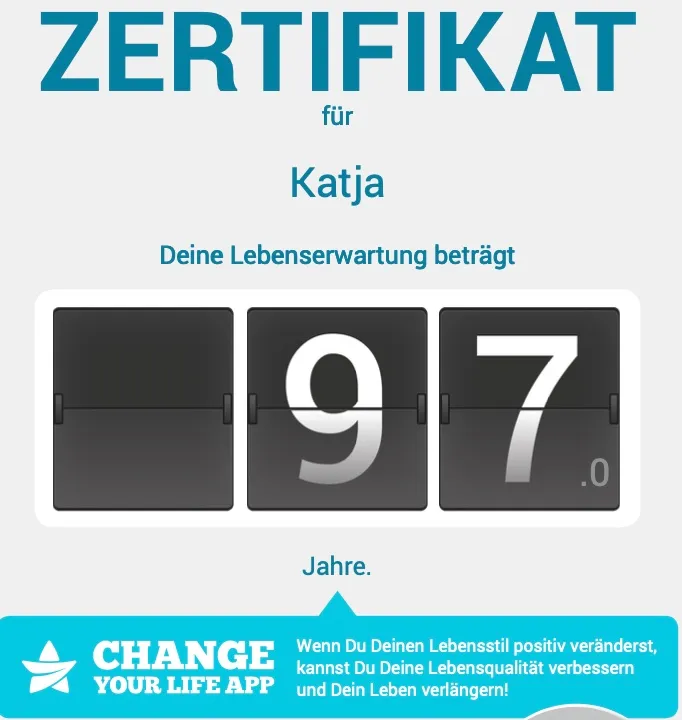
I was amazed that this calculator estimated my life expectancy at 97 years. The probability of living past 100 years is at 34%. However, the probability of needing long-term care was also quite high at 58%.
Of course, I was pleased about the prospect of such a long life. But what does that actually mean? And what does the relatively high probability of needing care imply?
First of all, I believe it is important to become aware of these facts. It means that even after the usual retirement age in the mid-60s, about one third of your life may still lie ahead of you. Our lifestyle helps determine whether we will reach the final third of our lives—and what condition we’ll be in when we get there. Financial planning also plays a major role in living a long and active life. Will savings plus a pension be enough for a good life if we live to 100? Have we prepared sufficiently in case we need long-term care? Women in particular often have a significant pension gap because they paused their careers or worked part-time due to raising children.
My Conclusion
Of course, such life expectancy calculations only reflect average probabilities
Important Note:
The content of this blog/newsletter is provided for general informational purposes only and does not replace personal medical advice, diagnosis, or treatment. The information presented here should therefore not be used as the sole basis for making health-related decisions. If you experience any medical complaints, you should in any case seek professional medical advice.
Vibrant Longevity Blog
How can you recover your health? How can you stay healthy?
Holistic physician and author Dr. Katja Aschenbrenner, MD, shares valuable insights from her clinical practice on functional medicine, gut health, hormones, Ayurveda, and everything that keeps us truly alive — for anyone who wants to understand their health and achieve vital longevity.
About Dr. Katja Aschenbrenner, MD
I am Dr. Katja Aschenbrenner. When no one else can find the root cause, my work begins. I support people with persistent exhaustion, unclear symptoms, or chronic illnesses using an integrative and functional medicine approach.
Connect with me
Stay up to date and connect with me on social media.