Introduction
We have some exciting news to share!
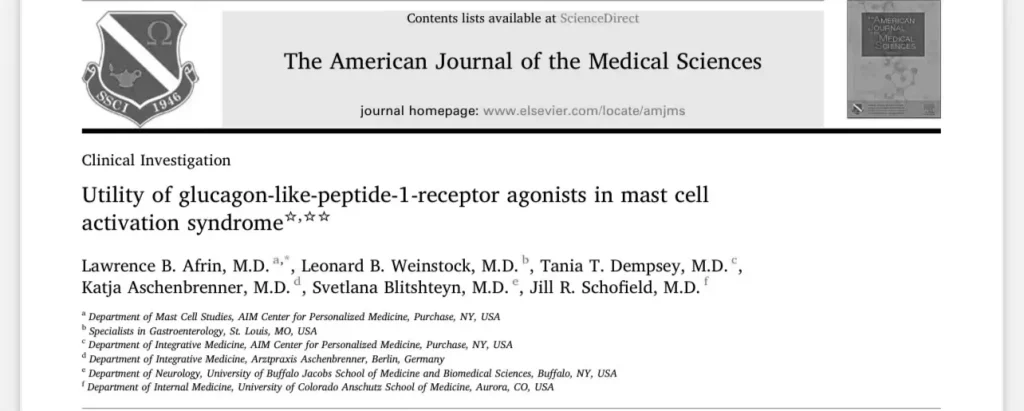
Together with a group of renowned American MCAS researchers and very experienced MCAS physicians, we conducted a study on the effectiveness of GLP-1 receptor agonists (“weight-loss injections”) in patients with mast cell activation syndrome (MCAS) — with results that give hope.
I am extremely pleased that our study was accepted for publication by the prestigious „The American Journal of the Medical Sciences“. It was a special honor for me to collaborate with MCAS pioneer and one of the very first physicians to describe the disease, Dr. Lawrence Afrin.
An easy-to-understand summary of the research paper
What is Mast Cell Activation Syndrome (MCAS)?
Mast Cell Activation Syndrome (MCAS) is a condition in which mast cells — which normally play a role in immune defense and fighting infections — become excessively active. This overactivity causes mast cells to release increased amounts of signaling substances (mediators), which can trigger inflammatory and allergy-like symptoms in many different parts of the body.
Unfortunately, this is not a rare condition. It is estimated that 17–20% of the population may be affected by MCAS.
Symptoms can be very diverse and affect multiple organ systems, for example the skin (rashes, itching), gastrointestinal tract (diarrhea, nausea, intolerances), cardiovascular system (low blood pressure, rapid heartbeat), respiratory tract (shortness of breath), and many more.
Why is this study so important?
MCAS is complex and multifaceted
In Mast Cell Activation Syndrome (MCAS), symptoms can vary greatly from person to person. Typically, however, those affected suffer from many different symptoms across several organ systems at the same time.
Precisely because MCAS can present in so many different ways, it is often difficult to quickly find the most suitable treatment for each individual patient.
We therefore examined whether an already well-known class of medications — GLP-1 receptor agonists — normally used to treat type 2 diabetes and obesity, might also help in MCAS. This class of drugs is better known under brand names such as Ozempic® (semaglutide) or Mounjaro® (tirzepatide), and is commonly referred to simply as weight-loss drugs.
What did we do?
We observed 47 people with MCAS (ages 15–71, 89% women) who received different GLP-1 medications (because previous treatment attempts had not been sufficiently successful).
Key results
- 89% of participants experienced a clear improvement in symptoms, such as less pain, fewer gastrointestinal problems, less fatigue, fewer allergic symptoms, and more stable weight.
- Positive effects often appeared within just a few days.
- Major side effects occurred only rarely.
What does this mean?
GLP-1 receptor agonists may represent a new treatment option for many people with MCAS. However, before they can be widely recommended, larger clinical studies are needed to confirm the observed effectiveness and to determine the best and safest dosage.
Why do weight-loss drugs work in MCAS?
Interestingly, mast cells have receptors for GLP-1. The medication binds directly to GLP-1 and/or GIP receptors on mast cells. This likely stabilizes the mast cells and reduces so-called degranulation — the process in which mast cells release signaling substances. As a result, these substances are released less frequently and/or less uncontrollably. Overall, this has an anti-inflammatory effect.
My US colleague Dr. Tania Dempsey writes the following about the possible mechanism of action:
Important note:
The content of this blog/newsletter is provided for general informational purposes only and does not replace personal medical advice, diagnosis, or treatment. The information presented here should therefore not be used as the sole basis for making health-related decisions. If you experience any medical complaints, you should in any case seek professional medical advice.
Vibrant Longevity Blog
How can you recover your health? How can you stay healthy?
Holistic physician and author Dr. Katja Aschenbrenner, MD, shares valuable insights from her clinical practice on functional medicine, gut health, hormones, Ayurveda, and everything that keeps us truly alive — for anyone who wants to understand their health and achieve vital longevity.
About Dr. Katja Aschenbrenner, MD
I am Dr. Katja Aschenbrenner. When no one else can find the root cause, my work begins. I support people with persistent exhaustion, unclear symptoms, or chronic illnesses using an integrative and functional medicine approach.
Connect with me
Stay up to date and connect with me on social media.